Formal informal and non formal education types explained with pdf ppt
Table of Contents
- Defining Formal, Informal, and Non-Formal Education: Core Concepts and Distinctions
- Historical Evolution and Global Milestones
- Comparative Analysis: Formal, Informal, and Non-Formal Education
- Structures and Delivery Mechanisms in Formal, Informal, and Non-Formal Education
- Institutional Structures and Governance in Formal Education
- Delivery Mechanisms in Informal Education Through Social Learning Theory
- Curriculum and Pedagogy: Designing Learning Experiences Across Formal, Informal, and Non-Formal Education
- Curriculum Design Principles: Formal Education and Tyler’s Rational Model
- Pedagogical Strategies in Informal Education: Scaffolding and Situated Learning
- Designing Non-Formal Education Modules: A Practical Template
- 1. Learning Objectives (SMART Goals)
- 2. Assessment Methods: Portfolio-Based and Peer Feedback
- 3. Resource Allocation: Budget, Tools, and Human Resources
Education transcends classrooms, weaving through structured institutions and spontaneous life experiences. The distinctions between formal, informal, and non-formal learning shape global education systems, yet their blurred boundaries often spark confusion. From UNESCO’s landmark definitions to grassroots literacy programs in rural India, these models reflect evolving societal needs—where a university degree meets the wisdom passed down through generations or the skills honed on a digital platform. Understanding their interplay is not just academic; it redefines how knowledge is accessed, validated, and transformed in an era where learning is boundless yet fragmented.
The rise of vocational training institutes alongside community storytelling circles exemplifies how education adapts to cultural and technological shifts. While formal systems rely on accredited credentials, informal learning thrives in unstructured environments like family traditions or online forums. Non-formal education bridges the gap, offering flexible pathways through open universities or UNESCO’s lifelong learning centers. This dynamic trio challenges traditional hierarchies, demanding a closer look at how each model operates, intersects, and reshapes modern education landscapes.

Defining Formal, Informal, and Non-Formal Education: Core Concepts and Distinctions
The classification of education into formal, informal, and non-formal systems serves as a foundational framework for understanding how learning occurs across diverse contexts. These categories, though distinct in structure and purpose, often intersect in practice, shaping global educational policies and individual learning trajectories. The distinctions were first formalized by international organizations like UNESCO, which played a pivotal role in defining these terms to address gaps in traditional education systems. The 1972 UNESCO International Conference on Adult Education marked a turning point, emphasizing the need for flexible learning pathways beyond conventional schooling. Later, the 1997 Delors Report (Learning: The Treasure Within) solidified these categories by linking them to lifelong learning, economic development, and social equity. This evolution reflects a broader shift from rigid, institution-centric education to inclusive models that accommodate diverse needs, including those of marginalized populations. The historical progression of these education types is intertwined with global socio-political movements. For instance, the Bologna Process (1999), aimed at harmonizing higher education across Europe, reinforced the dominance of formal education while inadvertently highlighting its limitations in addressing skill gaps in a rapidly changing labor market. Meanwhile, national policies in countries like Brazil’s Programa Nacional de Educação na Reforma Agrária and South Africa’s Further Education and Training (FET) Colleges exemplify efforts to integrate non-formal and informal learning into structured educational frameworks. These developments underscore the dynamic nature of education systems, where formal, informal, and non-formal learning are not isolated but often complementary.
Historical Evolution and Global Milestones
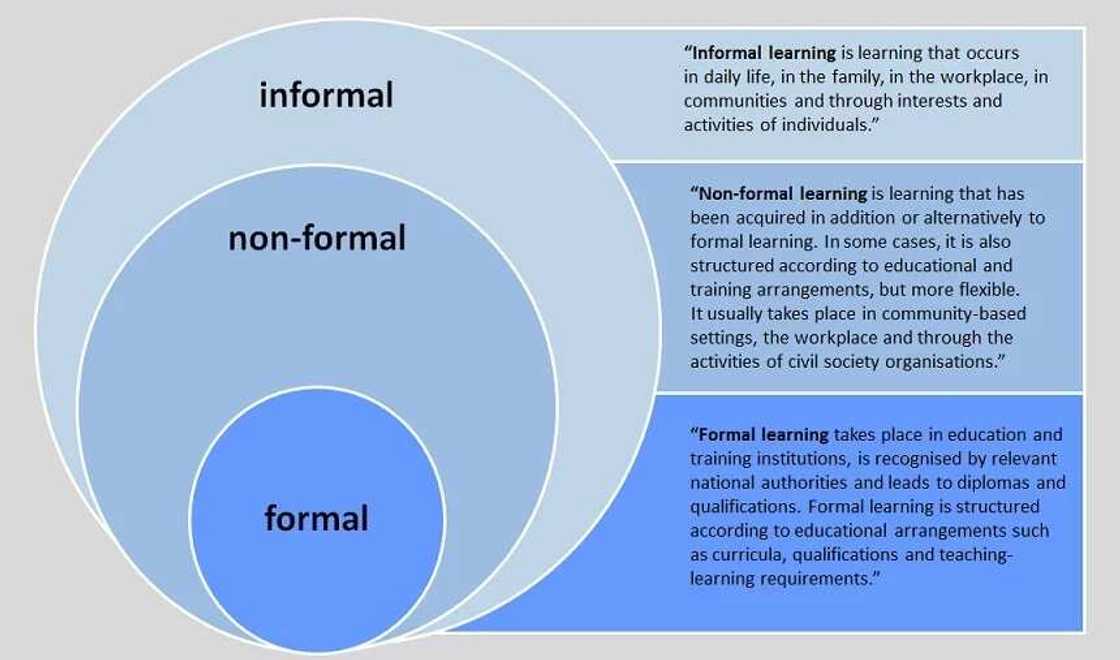 The trajectory of formal, informal, and non-formal education can be traced through key milestones that reflect broader societal changes, technological advancements, and policy responses to educational inequities.
"Education is not the filling of a pail, but the lighting of a fire." — William Butler Yeats (often cited in discussions on informal learning)
The 19th century witnessed the rise of formal education systems, particularly in Western nations, as governments established compulsory schooling to standardize literacy and civic values. This period laid the groundwork for the massification of education, a trend that continued into the 20th century with the UNESCO’s 1948 recommendation advocating for universal primary education. However, by the 1960s, critics such as Paul Lengrand and Malcolm Skilbeck argued that formal education alone could not address the needs of a diversifying global workforce or the millions excluded from traditional classrooms. The 1970s and 1980s saw a paradigm shift with the recognition of informal and non-formal education as legitimate pathways to learning. UNESCO’s 1972 Tokyo Conference introduced the term non-formal education to describe structured learning outside the conventional school system, targeting adults, youth, and marginalized groups. This was further elaborated in the 1976 UNESCO Report on Non-Formal Education, which defined it as: > "Any organized educational activity outside the established formal system which is intended to serve specific learning communities." The Delors Report (1997) expanded this framework by emphasizing lifelong learning and the interplay between the three education types. It highlighted four pillars of learning: 1. Learning to know (formal education), 2. Learning to do (non-formal/vocational training), 3. Learning to live together (informal/social learning), 4. Learning to be (holistic development across all types). Regional initiatives followed, such as:
In low-income countries, the World Bank’s Education Sector Development Programs often blend all three types, such as Ethiopia’s Community-Based Education (informal) and Pakistan’s Madrasa Reform Programs (non-formal), which integrate religious and vocational training.
Comparative Analysis: Formal, Informal, and Non-Formal Education

| Category | Definition | Key Characteristics | Examples | Institutional Framework |
|---|---|---|---|---|
| Formal Education | "Structured, chronologically graded, and hierarchically organized education with a clear objective of providing certified qualifications."— UNESCO, 1997 | |||
| - Institution-based (schools, universities)- Standardized curriculum- Age-specific cohorts- Credentialing (degrees, diplomas)- Teacher-led, structured environment | - Primary, secondary, and tertiary education (e.g., ICSE, IB, MIT degrees)- Apprenticeship programs with certification (e.g., Germany’s Dual System)- Online degree programs (e.g., Coursera partnerships with universities) | - Ministries of Education (e.g., U.S. Department of Education)- Accreditation bodies (e.g., ABET for engineering programs)- International organizations (e.g., OECD PISA assessments) | ||
| - Highly regulated by national/international standards- Focus on cognitive and disciplinary learning- Limited flexibility in content delivery | - Military academies (e.g., West Point)- Medical schools with residency requirements | - Standardized testing (e.g., SAT, GAOKAO in China)- Teacher certification boards | ||
| Non-Formal Education | "Intentional learning activities organized outside the formal system but structured and purpose-driven, often targeting specific skills or social groups."— UNESCO, 1972 | |||
| - Voluntary participation- Flexible timing and location- Skill-specific or community-oriented- May lead to certification (e.g., badges, vocational licenses)- Often funded by NGOs or governments | - Vocational training institutes (e.g., India’s ITIs)- Corporate training programs (e.g., Google’s Grow with Google)- Community colleges offering non-degree courses- Bridging programs for immigrants (e.g., Canada’s LINC) | - National vocational training boards (e.g., National Skills Development Corporation in India)- UN agencies (e.g., UNICEF’s Child-Friendly Spaces)- Private sector partnerships (e.g., Cisco Networking Academy) | ||
| Context | Delivery Mechanism | Social Learning Application | Bandura’s Process |
|---|---|---|---|
| Family Traditions | Oral storytelling, rituals, daily routines | Children learn cultural values by observing parents’ behaviors (e.g., hospitality, religious practices). | Attentional + Retention |
Curriculum and Pedagogy: Designing Learning Experiences Across Formal, Informal, and Non-Formal Education
Curriculum and pedagogy serve as the backbone of educational design, shaping how learners acquire knowledge, skills, and attitudes across diverse learning environments. In formal education, structured curriculum models like Tyler’s Rational Model dominate, emphasizing systematic planning, objectives, and evaluation. Conversely, informal education thrives on emergent learning—unplanned yet purposeful experiences—while non-formal education bridges the gap with flexible, community-driven modules. This section explores the principles of curriculum design, pedagogical strategies unique to each education type, and practical frameworks for integrating cross-disciplinary and culturally adaptive approaches. Case studies from STEM education, indigenous knowledge systems, and maker spaces illustrate how these methodologies redefine learning experiences beyond traditional classrooms.
Curriculum Design Principles: Formal Education and Tyler’s Rational Model
Formal education systems rely on structured, outcomes-driven curriculum design, where clarity of purpose and measurable goals are paramount. Ralph Tyler’s Rational Model (1949), a foundational framework in curriculum development, outlines four key phases: identifying learning objectives, selecting content, organizing experiences, and evaluating outcomes. This model assumes a linear, top-down approach, where educators define what students should know and how they will demonstrate mastery. For instance, a high school biology curriculum using Tyler’s model would begin with SMART objectives (e.g., "By the end of the semester, students will explain cellular respiration with 90% accuracy on assessments"), followed by modular content (e.g., mitosis, photosynthesis), hands-on labs for experiential learning, and standardized tests for evaluation. Contrast with Emergent Curriculum in Informal Settings Unlike formal education’s rigid structure, informal learning thrives on spontaneity and real-world relevance. The emergent curriculum approach, common in hackathons, community workshops, or online forums, prioritizes learner-driven exploration over predefined outcomes. For example, a 24-hour coding hackathon may begin with a broad theme (e.g., "Develop AI solutions for climate change") but evolves based on participant interests, leading to unpredictable yet highly engaging learning paths. Here, pedagogical control shifts from instructors to facilitators, who provide resources (e.g., APIs, mentorship) while allowing participants to self-direct their projects. Tools like agile development methodologies or design thinking sprints further emphasize iterative problem-solving, where curriculum emerges from collaborative experimentation rather than pre-set syllabi.
"Emergent curriculum is not the absence of planning but the presence of responsiveness to the needs and interests of learners in the moment." — Lella Gandini (Developmental Psychologist)
Pedagogical Strategies in Informal Education: Scaffolding and Situated Learning
Informal education leverages social and contextual learning theories to create meaningful, experiential growth. Two key strategies—scaffolding (Wood, Bruner, 1976) and situated learning (Lave & Wenger, 1991)—demonstrate how support structures and real-world contexts accelerate mastery. Scaffolding in Apprenticeships Scaffolding involves temporary support to help learners bridge gaps between their current and desired competence. In traditional apprenticeships (e.g., blacksmithing or carpentry), a master craftsman gradually reduces guidance as the apprentice gains skills. For example:
This zone of proximal development (ZPD) ensures learners progress without frustration or stagnation. Digital adaptations, such as online coding bootcamps, use interactive tutorials (e.g., Codecademy’s instant feedback) to scaffold programming skills. Situated Learning in Community Storytelling Lave and Wenger’s situated learning theory posits that knowledge is constructed through social participation in authentic activities. Indigenous communities, for instance, teach oral history and cultural practices through storytelling circles, where elders narrate Dreamtime stories (Australia) or Maori whakapapa (New Zealand). Learners absorb values, history, and survival skills not through lectures but by participating in rituals, hunting, or crafting. A practical example:
"Learning is a social process that occurs when individuals engage in meaningful activities within communities of practice." — Jean Lave & Étienne Wenger (Situated Learning Theory)
Designing Non-Formal Education Modules: A Practical Template
Non-formal education—such as corporate training, NGO workshops, or adult literacy programs—requires flexible yet structured modules that balance learner autonomy and measurable outcomes. Below is a template for designing non-formal education programs, incorporating SMART objectives, participatory assessment, and resource allocation.
1. Learning Objectives (SMART Goals)
Non-formal education modules must define specific, measurable, achievable, relevant, and time-bound (SMART) objectives to ensure alignment with participant needs. Unlike formal education, these goals often focus on skills acquisition rather than academic credentials. Example:
- Module Title: "Digital Literacy for Rural Entrepreneurs"
- Objective 1: "By Week 4, 80% of participants will create and publish a functional e-commerce store using free platforms (e.g., WooCommerce)."
- Objective 2: "Participants will identify three digital marketing strategies (e.g., social media, SEO) and apply one to their business within 30 days of completion."
- Objective 3: "90% of learners will demonstrate basic cybersecurity practices (e.g., password management, phishing awareness) via a quiz."
2. Assessment Methods: Portfolio-Based and Peer Feedback
Assessment in non-formal education prioritizes authentic, formative evaluations over summative exams. Two effective methods include:
- Portfolio Assessments: Participants compile work samples (e.g., a farmer documenting their progress in using agritech tools via photos, journal entries, and videos). Portfolios allow self-reflection and instructor feedback on real-world applications.
- Peer Feedback: Structured group critiques (e.g., using tools like Miro or Padlet) enable learners to evaluate each other’s projects, fostering collaborative learning. Example: In a community cooking class, participants rate peers on nutrition balance, presentation, and creativity using a rubric.
- Reflective Journals: Learners submit weekly reflections on challenges and insights, which instructors use to adjust teaching strategies mid-program.
3. Resource Allocation: Budget, Tools, and Human Resources
Non-formal education often operates with limited budgets, requiring creative resource management. A sample breakdown for a 5-week financial literacy workshop in a low-income community:
| Category | Resource | Cost (USD) | Justification |
|---|---|---|---|
| Human Resources | Facilitator (part-time) | $300 | Local finance expert paid per session; reduces overhead. |
| Peer Mentors (2) | $150 | Volunteers with basic accounting skills assist in group activities. | |
| Tools & Materials | Tablets for digital exercises | $500 | 5 used tablets shared among 2
Formal, informal, and non-formal education are not isolated silos but interconnected threads in the fabric of learning. From the rigid governance of universities to the organic growth of digital communities, each model serves distinct purposes while influencing the others. The key lies in recognizing their strengths—structured rigor, experiential adaptability, and flexible accessibility—and leveraging them to create inclusive, future-ready education systems. As technology and societal needs evolve, the debate over their distinctions will persist, but one truth remains: true education thrives where boundaries dissolve and learning knows no limits. |
Leave a Comment
Comments are moderated before appearing. The data you submit is processed according to the Privacy Policy of Findatopdoc.