Top meaning English unravels linguistic power and cultural impact
Table of Contents
- Understanding the Core Definitions of "Top" in English
- Grammatical Roles and Contextual Adaptability
- Top as a Noun: Physical, Hierarchical, and Qualitative Meanings
- Top as an Adjective: Modifying Nouns for Superiority and Specialization
- Top as an Adverb: Describing Actions of Achieving Prominence
- Idiomatic Expressions Featuring "Top": Cultural and Emotional Implications
- Historical Evolution and Etymology of the Word "Top"
- Etymological Origins and Old English Foundations
- Evolution from Physical Object to Abstract Concept
- Regional Dialects and Pronunciation Variations
- Etymological Shifts Across Centuries
- Practical Applications of "Top" in Everyday Language
- Rankings and Hierarchies: The Psychological Power of "Top" in Lists and Achievements
- Product Branding and Marketing: How "Top" Drives Consumer Trust and Sales
- Instructions and Directions: Spatial and Priority Cues Using "Top"
- Sports Terminology: "Top" in Competitive Narratives and Performance Metrics
- Common Collocations Involving "Top": A Lexical Toolkit for Precision
- Cultural and Symbolic Representations of "Top" in Global Contexts
- Excellence and Superiority in Western Culture: Institutionalizing the "Top" Hierarchy
- "Top" in Music and Entertainment: Charting Cultural Dominance
- "Top" in Fashion and Design: The Illusion of Elite Accessibility
- Visual Arts and Literature: "Top" as Perspective and Power
- Regional Comparisons: Cultural Interpretations of "Top"
- Metaphorical "Top" in Philosophy and Spirituality
Language evolves through words that transcend their literal definitions, and "top" stands as a prime example of such versatility. From denoting physical elevation to symbolizing excellence in abstract realms, this unassuming three-letter word weaves through conversations, rankings, and cultural narratives with remarkable adaptability. Its journey spans centuries, embedding itself in idioms, scientific terminology, and everyday speech, yet its core essence—positioning and superiority—remains universally recognizable.
Beyond its grammatical roles as noun, adjective, and adverb, "top" operates as a silent architect of perception, shaping how audiences interpret achievements, hierarchies, and even emotional states. Whether in a corporate "top-performer" badge or the euphoric idiom "on top of the world," its applications reveal a word that is as practical as it is symbolic. This exploration dissects "top" not just as a lexicon entry, but as a linguistic phenomenon that mirrors societal values and aspirations.

Understanding the Core Definitions of "Top" in English
The word "top" is a linguistic staple in English, adaptable across nouns, adjectives, and adverbs while retaining a core essence of superiority, position, or excellence. Its versatility stems from its ability to function in diverse contexts—from describing physical locations to signifying hierarchical rankings or exceptional quality. Mastering its grammatical roles and contextual nuances enhances precision in communication, whether in formal writing, everyday speech, or specialized fields like business, sports, or technology. This section dissects the primary definitions of "top," illustrating how its meaning evolves with grammatical function and contextual application.
Grammatical Roles and Contextual Adaptability
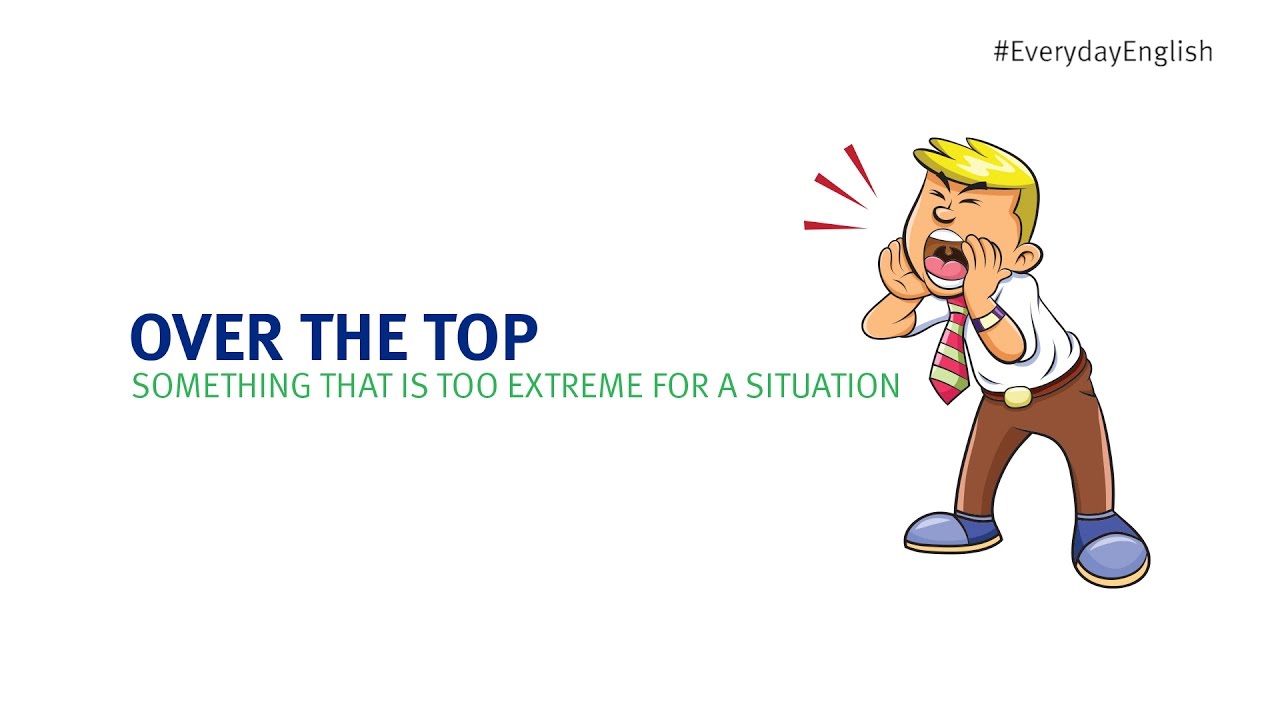 The word "top" operates as a noun, adjective, and adverb, each role shaping its meaning and usage. As a noun, it often denotes physical elevation (e.g., the top of a mountain), but it also extends to abstract concepts like rankings (top performer) or quality (top-tier product). When used as an adjective, it modifies nouns to imply superiority (e.g., top-secret documents), while as an adverb, it describes actions achieving prominence (e.g., top the sales chart). Contextual shifts—such as spatial, evaluative, or hierarchical—dictate its precise interpretation. Below, a comparative analysis highlights these distinctions, emphasizing how grammatical function and context collaborate to define "top."
Top as a Noun: Physical, Hierarchical, and Qualitative Meanings
As a noun, "top" serves three primary functions: physical position, ranking/order, and quality/excellence. Its meaning hinges on context, where spatial, hierarchical, or evaluative frameworks dictate interpretation. Physical Position In spatial contexts, "top" refers to the highest point of an object or structure. Examples include:
Here, "top" is tangible, often contrasted with "bottom" or "base." Visualizing a vertical axis (e.g., a building, a mountain) clarifies its usage. Hierarchical or Ranking Contexts "Top" signifies superiority in order or position, frequently appearing in lists, charts, or competitive scenarios:
In these cases, "top" implies achievement or precedence, often paired with modifiers like "top-ranked" or "top-performing." Quality and Excellence Beyond position, "top" denotes exceptional quality, as seen in phrases like:
Here, "top" functions as a qualitative descriptor, akin to "elite" or "premium," though lacking the formal connotation of adjectival forms (e.g., "top-notch").
Top as an Adjective: Modifying Nouns for Superiority and Specialization
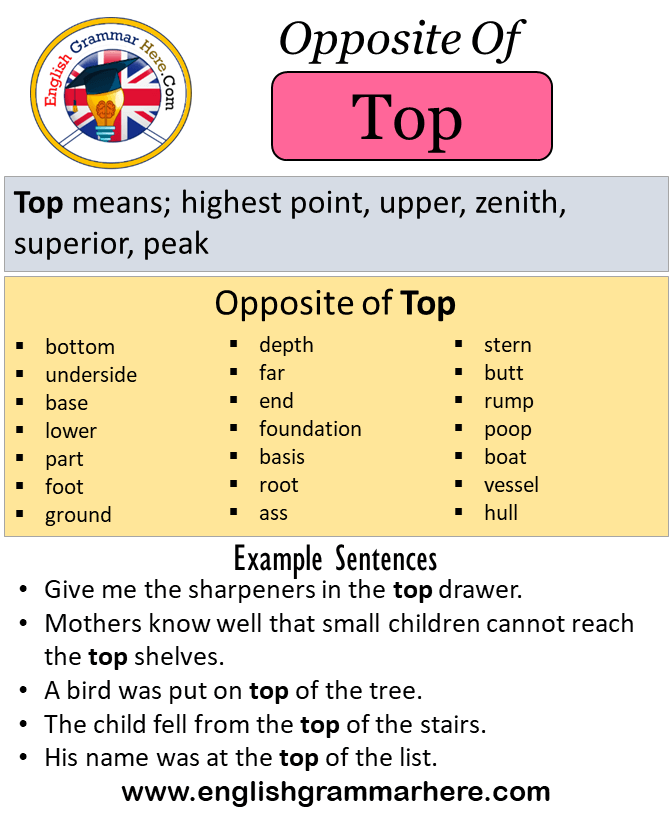 When functioning as an adjective, "top" modifies nouns to convey excellence, exclusivity, or hierarchy. Its usage often pairs with hyphenated compounds (e.g., top-secret) or nouns describing categories (e.g., top-tier). The adjective form amplifies the noun’s status, frequently in professional, technical, or classified contexts.
Common Adjectival Phrases and Their Nuances
The following table contrasts key adjectival usages of "top," illustrating how context refines its connotation:
When functioning as an adjective, "top" modifies nouns to convey excellence, exclusivity, or hierarchy. Its usage often pairs with hyphenated compounds (e.g., top-secret) or nouns describing categories (e.g., top-tier). The adjective form amplifies the noun’s status, frequently in professional, technical, or classified contexts.
Common Adjectival Phrases and Their Nuances
The following table contrasts key adjectival usages of "top," illustrating how context refines its connotation:
| Meaning | Part of Speech | Example Sentence | Nuance/Connotation |
|---|---|---|---|
| Physical Superiority | Adjective | The top layer of the cake was decorated with gold leaf. | Refers to a literal uppermost part, often in tangible objects. |
| Hierarchical Ranking | Adjective | She joined the top management team after 20 years. | Implies elite status within an organizational structure. |
| Exceptional Quality | Adjective | The hotel offers top-notch customer service. | Conveys unparalleled excellence, often in service or products. |
| Classified/Restricted Access | Adjective | The top-secret files were stored in a vault. | Indicates high confidentiality, typically in government or military contexts. |
| Performance or Achievement | Adjective | His top score in the competition was 98%. | Highlights peak performance, often in competitive or academic settings. |
Hyphenated Compounds and Professional Jargon Adjectival "top" frequently forms hyphenated phrases that carry specialized meanings:
These compounds are domain-specific, with connotations varying by field (e.g., business, military, academia).
Top as an Adverb: Describing Actions of Achieving Prominence
As an adverb, "top" modifies verbs to indicate reaching the highest point in a ranking, performance, or hierarchy. Its usage is dynamic, often tied to achievement, competition, or progression. Unlike its noun or adjective forms, adverbial "top" emphasizes action and result, particularly in contexts where surpassing others is key. Key Adverbial Usages and Examples Adverbial "top" frequently appears in phrases like:
Idiomatic and Figurative Adverbial Uses Beyond literal rankings, "top" as an adverb extends into figurative language, often evoking emotion or metaphorical height:
These usages blend literal and metaphorical interpretations, enriching descriptive language.
Idiomatic Expressions Featuring "Top": Cultural and Emotional Implications
Idiomatic phrases with "top" transcend literal definitions, embedding cultural, emotional, or situational nuances. These expressions often rely on metaphorical height to convey states of mind, achievements, or spatial relationships. Understanding their connotations reveals deeper layers of English idiomatic speech. Common Idioms and Their Meanings The following idioms illustrate the emotional and cultural weight of "top" in everyday language:
- On top of the world: Describes an overwhelming sense of happiness or success. Example: After winning the award, she felt on top of the world. Connotation: Euphoria, triumph, or emotional peak.
- From top to bottom: Indicates complete coverage or thoroughness. Example: The building was renovated from top to bottom. Connotation: Exhaustiveness, often in physical or organizational contexts.
-
At the top of one’s game: Refers to peak performance or skill.
Example: The athlete was at the top of her game during the Olympics.
Connotation: Mastery, excellence
Historical Evolution and Etymology of the Word "Top"
The word "top" carries a rich linguistic legacy, tracing its roots through centuries of English evolution while adapting to reflect cultural, scientific, and technological advancements. From its Old English origins to its modern multifaceted usage—spanning physical objects, abstract hierarchies, and specialized terminology—its journey mirrors broader shifts in language, society, and human cognition. This exploration examines how "top" transitioned from a tangible spinning toy to a symbol of superiority, leadership, and even mathematical precision, while also revealing lesser-known archaic meanings and regional variations that continue to influence its contemporary application.Etymological Origins and Old English Foundations
The word "top" originates from the Old English topp, derived from the Proto-Germanic tup-, meaning "peak," "summit," or "highest point." This root also connects to the Old Norse toppr and the Gothic tup (meaning "peak" or "ridge"), illustrating its Indo-European ancestry. Early attestations in Old English texts, such as those from the 8th–11th centuries, often describe "top" as a physical summit or extremity, particularly in geographical or architectural contexts. For instance, in the Anglo-Saxon Chronicle (c. 9th century), references to "topan" (the top of a hill or mound) underscore its primal association with elevation. By the Middle English period (1100–1500), "top" expanded beyond mere physical height to include metaphorical superiority. Chaucer’s The Canterbury Tales (c. 14th century) employs "top" in phrases like "the top of honour" to denote social or moral preeminence, signaling its transition into abstract domains. This shift reflects the broader medieval emphasis on hierarchy and divine order, where "top" symbolized not just physical height but also spiritual or feudal dominance.Evolution from Physical Object to Abstract Concept
The 16th–18th centuries marked a pivotal era for "top" as it diverged into distinct semantic pathways: physical objects, games, and abstract hierarchies. One of the most enduring associations emerged with the spinning toy, likely influenced by the Dutch "tobbe" or French "toupie" (both meaning "whirl" or "spin"). The 16th-century English toy "top"—a small, rotating object—became a cultural staple, immortalized in nursery rhymes like "The Top That Spins" (17th century). This playful usage contrasts sharply with its nautical and military applications, where "top" denoted highest points on ships (e.g., "topmast") or fortifications (e.g., "battery top"), reflecting the era’s maritime and defensive priorities. Simultaneously, "top" infiltrated social and political discourse as a marker of rank or authority. The phrase "at the top of the ladder" (17th century) encapsulated the Protestant work ethic and meritocracy, while "top dog" (18th century) emerged in American slang to describe dominance or leadership. By the 19th century, "top" had solidified in administrative and corporate language, with terms like "top management" and "top secret" (coined during World War II) embedding it in modern bureaucratic and security lexicons.Regional Dialects and Pronunciation Variations
Regional English dialects have imparted nuanced variations in "top"’s pronunciation and usage, often tied to social class, migration, and cultural exchange. In British English, "top" retains a broader range of archaic meanings, such as: - "Top" as a suffix: "Top-heavy" (unstable) or "top-notch" (excellent), where the suffix form persists more strongly than in American English.
- Nautical terms: "Fore-top" (the upper part of a ship’s mast) or "top-gallant sail" remain in specialized maritime vocabulary.
- Rhotic pronunciation: In regions like Scotland and Northern England, the "-p" sound is often pronounced with a strong "t" (e.g., "tope"), a remnant of older Germanic inflections. In contrast, American English streamlined "top" into a more generalized, abstract term, with variations emerging in:
- Southern U.S. dialects: "Y’all are at the top of your game" (hyperbolic praise).
- African American Vernacular English (AAVE): "He’s the top dog in this town" (dominance).
- Non-rhotic accents: The "-p" is frequently silent (e.g., "tope" → "toe" in casual speech), though standard pronunciation retains the "p" sound. Canadian and Australian English blend elements of both traditions, with "top" often used in sports (e.g., "top scorer") and slang (e.g., "top bloke" in Aussie English for "great guy"), reflecting their unique cultural syntheses.
- Top priority: The most urgent or important task. Example: "Finalizing the contract is our top priority this quarter."
- Top-notch: Of the highest quality or excellence. Example: "The restaurant is known for its top-notch customer service."
- Top performer: An individual or entity excelling in their field. Example: "She was named the top performer in the sales department."
- Top shelf: The highest level of quality or prestige. Example: "His whiskey is considered top shelf among connoisseurs."
- Top-secret: Classified information requiring strict confidentiality. Example: "The mission details were marked as top-secret."
- Top-heavy: Over-reliant on a small group (often leadership) at the expense of others. Example: "The company’s top-heavy management structure led to inefficiencies."
- Top-tier: Belonging to the highest category or level. Example: "The university offers top-tier research facilities."
-
Top up: To add more of something
Cultural and Symbolic Representations of "Top" in Global Contexts
The concept of "top" transcends its literal meaning, embedding itself deeply into cultural narratives as a symbol of superiority, achievement, and dominance. Across societies, the term evolves into a multifaceted metaphor—representing excellence in competitive hierarchies, artistic dominance in creative fields, and even spiritual aspiration. From award ceremonies that crown the "best" to fashion runways showcasing "top models," the cultural weight of "top" reinforces societal values of meritocracy, innovation, and visibility. This exploration dissects how "top" manifests in Western and non-Western contexts, revealing its role in shaping collective aspirations and reinforcing symbolic power structures.Excellence and Superiority in Western Culture: Institutionalizing the "Top" Hierarchy
In Western societies, "top" is institutionalized through awards, rankings, and media-driven narratives that elevate individuals, brands, or entities to positions of unparalleled prestige. The Oscars, Grammy Awards, and Forbes "Top 100" exemplify how "top" is not merely descriptive but aspirational—driving public perception of success and worth. Media outlets like Billboard and Time Magazine further cement this hierarchy by publishing "Top 40" charts or "Person of the Year" lists, which influence consumer behavior, career trajectories, and even political discourse. Key Mechanisms of Symbolic Power: - Competitive Rankings: Sports leagues (e.g., NFL’s "Top Draft Picks") and academic institutions (e.g., QS World University Rankings) use "top" to signal elite status, often tied to economic or social capital.
- Corporate Dominance: Terms like "market leader" or "top-performing" in business (e.g., Apple being the "top-valued brand" globally) reflect monopolistic aspirations and consumer trust.
- Media Amplification: News cycles frequently highlight "top stories" or "must-see" events, framing certain narratives as inherently superior to others, thus shaping collective attention.
- Music Industry: The "Top 40" format, originating in the 1950s, standardizes success metrics, prioritizing radio-friendly tracks over artistic innovation. Artists like The Beatles and Taylor Swift have capitalized on this by dominating "top charts" across decades.
- Film and Streaming: "Box office tops" (e.g., Avatar’s record-breaking runs) and "Netflix Top 10" lists influence global cinema, with studios often marketing films as "must-watch" based on early "top" rankings.
- Gaming and Esports: Terms like "top players" or "top streams" (e.g., Twitch’s "Top Games") create hierarchies that monetize skill, with sponsors and audiences flocking to "elite" content creators.
- Hierarchy of Brands: "Fast fashion" brands mimic "top luxury" designs, creating a paradox where exclusivity is both a selling point and a market strategy.
- Body Standards: The term "top model" implies a physical ideal, often reinforcing narrow beauty standards that dominate media representation.
- Sustainability Paradox: "Top sustainable brands" (e.g., Patagonia) use "top" to market ethical practices, though accessibility remains limited for many consumers.
- Architecture: "Top-heavy" designs (e.g., Burj Khalifa) symbolize human ambition, while "topography" in landscape art maps power dynamics (e.g., colonial city plans).
- Literature: "Top-down" narratives (e.g., Game of Thrones) often depict authoritarian rule, whereas "bottom-up" stories challenge hierarchies.
- Digital Art: "Top trending" hashtags on Instagram or "top creators" on DeviantArt use algorithms to reinforce digital elitism.
Etymological Shifts Across Centuries
The following table outlines key etymological and semantic shifts of "top" from the Old English period to the modern era, contextualized within historical records and literary examples.| Century | Historical Context | Example Usage in Literature/Records | ||||||||||||||||||||||||
|---|---|---|---|---|---|---|---|---|---|---|---|---|---|---|---|---|---|---|---|---|---|---|---|---|---|---|
| 8th–11th | Old English; emphasis on geography and warfare. "Top" denotes physical height (hills, mounds). | "Æfter þæm toppe þæt wæter ofslog" ("After the top where the water overflowed") – Beowulf (c. 8th–11th century, translated excerpts). |
||||||||||||||||||||||||
| 12th–14th | Middle English; feudal hierarchy and religious symbolism. "Top" extends to moral/spiritual superiority. | "To sitte at the toppe of honour" – Chaucer’s Canterbury Tales (c. 1387). |
||||||||||||||||||||||||
| 15th–16th | Renaissance; exploration and toy culture. "Top" as a spinning toy enters English via Dutch/French influence. | "A child’s toppe, whirling in the wind" – William Caxton’s translations (1476). |
||||||||||||||||||||||||
| 17th | Age of Enlightenment; scientific classification and social stratification. "Top" used in taxonomy and governance. | "The top of the social pyramid" – Thomas Hobbes, Leviathan (1651). |
||||||||||||||||||||||||
| 18th | Industrial Revolution; mechanization and slang development. "Top" in manufacturing ("top gear") and dominance ("top dog"). | "The engine ran at full top speed" – James Watt’s engineering manuals (1770s). |
||||||||||||||||||||||||
| 19th | Victorian era; bureaucracy and global expansion. "Top" in corporate ("top executive") and military ("top secret") contexts. | "The top brass of the army" – Charles Dickens, Little Dorrit (1857). |
||||||||||||||||||||||||
| 20th–21st | Digital and scientific age; abstract and technical repurposing. "Top" in algorithms ("top search results") and fields like topology. | *"The top quark was discovered in 19 |
Leave a Comment
Comments are moderated before appearing. The data you submit is processed according to the Privacy Policy of Findatopdoc.